
A Management Plan is the key strategic document that guides the protection, conservation, and development of a protected area. It defines how the area’s natural values will be preserved and enhanced, which activities should be carried out, and who is responsible for their implementation.
It is a long-term planning document developed for a period of at least five years, and most commonly ten years. As such, it provides the foundation for decision-making that shapes the future of a protected area.
What should a Management Plan include?
To provide clear guidance for protection and management, a Management Plan should answer several key questions:
- What makes the area unique?
An overview of its most important natural values, explaining why the area is significant and which characteristics led to its protected status.
- What challenges does it face?
An assessment of the condition of its natural values and the identification of the main pressures, threats, and factors that put them at risk.
- What future do we want to achieve?
A long-term vision, together with clearly defined objectives and the activities needed to achieve them.
- How will progress be measured?
The establishment of indicators, target values, and monitoring mechanisms to track progress toward the defined objectives.
What principles underpin a high-quality Management Plan?
A good Management Plan is more than a list of activities. It is a strategic document built on clear principles that enable effective implementation in practice.
- Biodiversity conservation at the heart of every decision
The primary purpose of protected areas is to conserve biodiversity, and this objective should be reflected throughout the plan’s measures and activities.
- Clear and measurable objectives
Objectives should follow the SMART principle, meaning they are specific, measurable, achievable, relevant, and time-bound.
- Science-based decision-making
Data used in the preparation of the plan must be systematically collected and analysed using relevant scientific methods.
- Balancing different interests
The plan should recognize and consider the interests, needs, and impacts of all stakeholders and area users.
- An open and participatory process
All relevant stakeholders should be actively involved in the planning process, ensuring transparency throughout.
- Flexibility and adaptation
Because natural systems are dynamic and often unpredictable, the plan should allow activities to be adjusted in response to lessons learned and results achieved on the ground.
How is a Management Plan developed?
A Management Plan is prepared by the protected area manager in cooperation with competent institutions, scientific organizations, area users, local communities, civil society organizations, and other relevant stakeholders.
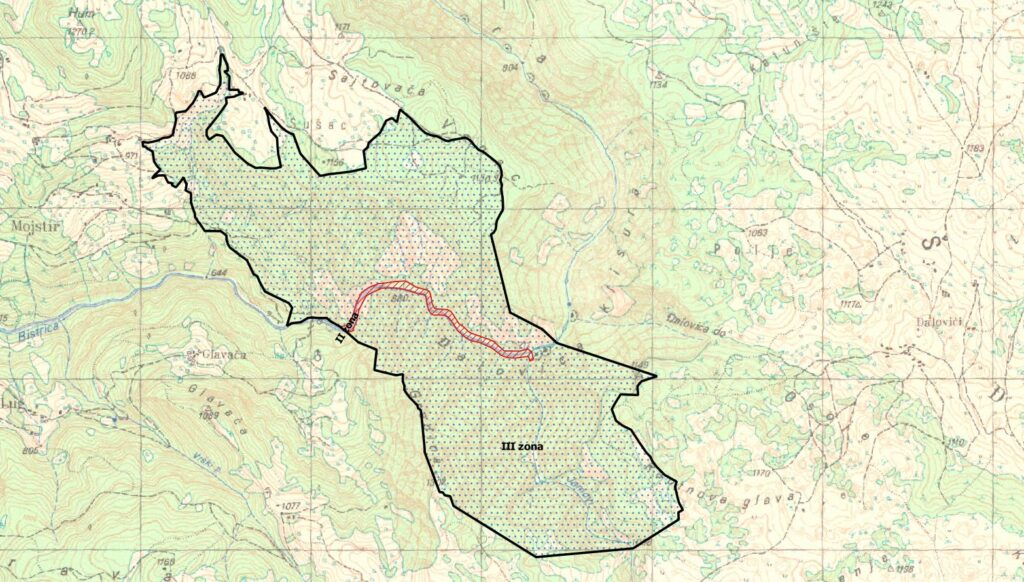
A high-quality Management Plan provides the foundation for the long-term protection and sustainable use of natural assets, but its true value is measured by the extent to which it is embraced and put into practice by the community. During the development of the Management Plan for the Đalovića Gorge Nature Monument, our goal was to ensure that the document would not remain merely words on paper, butbecome a shared vision for all stakeholders. It is precisely this broad dialogue and active involvement of the local community that create the conditions for nature conservation to be realistic, achievable, and aligned with the needs of people, Željko Madžgalj, Director of the Agency for the Management of Natural Assets of the Municipality of Bijelo Polje
Developing a Management Plan typically takes around one year. During this period, stakeholder workshops are organized, consultation meetings are held with key actors, data are collected and analysedfrom a range of relevant sources, and the process concludes with a legally required public consultation.
A good example of this approach is the preparation of the Management Plan for the Đalovića Gorge Nature Monument, during which three workshops were held, including a final workshop conducted as part of the public consultation process. Representatives of as many as 39 organizations and institutions participated. The workshops and public consultation enabled stakeholders to jointly identify key challenges, define a shared vision, and agree on management priorities, all of which were subsequently incorporated into the Management Plan.
From planning to action
An Action Plan is an integral part of every Management Plan. It provides an overview of all defined objectives, the activities required to achieve them, implementation timelines, responsible actors, and the estimated financial resources needed for delivery.
It is important to emphasize that a Management Plan is not the same as the manager’s operational work plan. Its scope is much broader, as it also includes activities that can be implemented by other institutions, organizations, or individuals, provided they contribute to the shared goals of protecting and improving the protected area.
A good Management Plan must strike a balance between ambition and reality, between what we aspire to achieve and what can realistically be delivered with the capacities and resources available. For this reason, sufficient time, expertise, and resources must be devoted to its preparation. A Management Plan is not merely a legal obligation, but the most important strategic document for guiding the management of a protected area.
However, even the best-written plan does not guarantee successful management on its own. How can we know whether planned activities are actually being implemented, whether desired results are being achieved, and whether management is effective in practice?
Find out more in next week’s article: Management in Practice and Monitoring Management Effectiveness.