
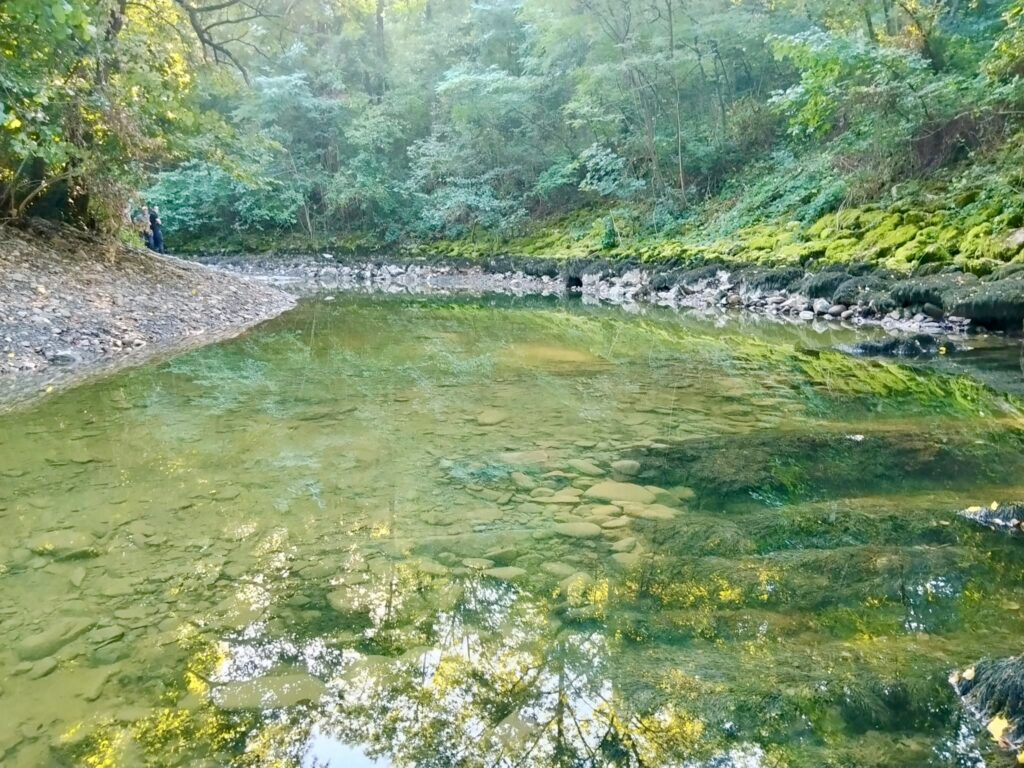
The Nature Conservancy (TNC), in cooperation with the Public Institution “Priroda” and Croatian Waters – the VGO for the Northern Adriatic Basins, conducted a pilot project for the restoration of part of the Rječina riverbed during August. The process removed 430 m³ of sediment and rock debris from the Črni vir microlocation in the upper reaches of the river, partially restoring the whirlpool to a favorable state of conservation.
The field work was fully funded by Croatian Waters. Although the work was carried out in the middle of a dry period, without precipitation, water began to accumulate in the whirlpool immediately after the intervention. This is an important result because the surface water in the Rječina riverbed, which dries up in the summer, is a refuge for all the river’s life.
The Black Whirlpool can thus once again perform its function in the ecosystem. Whirls are naturally deeper parts of the riverbed in which life survives during droughts, when the Rječina often does not flow; and when the river flows again, they soften and calm the flow by slowing down and swirling the water.
The white-legged crayfish (Austropotamobius pallipes) is extremely important for the life of the Rječina, a strictly protected species due to which the upper reaches of the Rječina are included in the European ecological network Natura 2000. In the Rječina, it is threatened, among other things, by the filling of the whirlpools with sediment that flows abundantly from torrential streams, such as the one in Duboko.
The local community and the Association “Spasimo Ričinu” actively participated in the implementation of the intervention, to which we would like to thank for their cooperation and contribution. We are pleased that we have shown through this example how, through joint efforts, we can work on the restoration of nature and the preservation of biodiversity.